
Before assessing rental yields, tourism growth, infrastructure expansion, or emerging destinations like Lombok, international investors want clarity on one thing: can they actually own property here?
The answer is yes, though the mechanism differs from the freehold systems most international investors know.
Indonesia's property system is built around structured land rights and regulated corporate vehicles that provide legal control, commercial capacity, and long-term security when applied correctly.
Indonesia's agrarian framework distinguishes between absolute freehold ownership and state-recognised land rights. Absolute freehold title, known as Hak Milik, is reserved exclusively for Indonesian citizens. Foreign participation operates through alternative, legally protected rights.
Hak Pakai allows foreign individuals holding valid Indonesian residency permits to use residential property for a defined term, generally up to 30 years with extensions. It's suited primarily to private residential occupation and doesn't support commercial-scale rental operations or hospitality businesses.
Hak Guna Bangunan (HGB) grants the right to construct and commercially utilise buildings on land for a fixed period. Foreign individuals cannot hold HGB directly, it must be held through a properly established PT PMA company.
Hak Sewa is a contractual arrangement between an investor and an Indonesian landowner that grants the right to use and develop land for an agreed term. Typically structured for 25 to 30 years with negotiated extensions, it provides long-term control at lower entry pricing than acquiring statutory title.
The moment the objective shifts to rental income, hospitality operations, property development for resale, or any structured commercial activity, a corporate vehicle becomes necessary. A PT PMA is a foreign-owned limited liability company established under Indonesian investment regulations, it's the legal entity through which foreign investors conduct business in Indonesia.
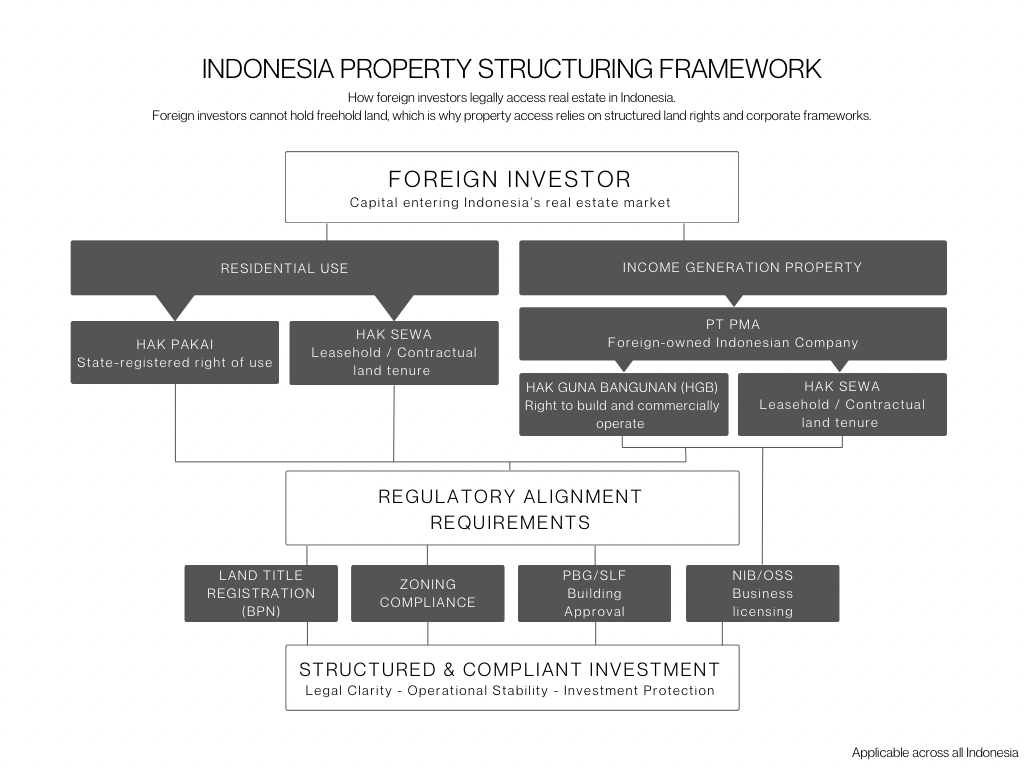
For investors developing or operating a resort in Indonesia, the combination of a long-term Hak Sewa leasehold held through a PT PMA is the structure experienced operators consistently use. Leasehold reduces entry cost without reducing control. PT PMA provides full commercial capacity. The combination is enforceable and scalable, and it is the structure underpinning every project in the MOJO portfolio.
Lombok is transitioning from an emerging land market into a structured tourism corridor, especially along the Kuta-Mandalika axis. As markets mature, compliance standards become part of performance. The structure investors enter with will determine not just their legal standing, but their operational performance and exit options.
Yes, though not through freehold title. Foreign investors access the market through Hak Pakai (Right to Use), Hak Guna Bangunan (Right to Build) held through a PT PMA company, or Hak Sewa leasehold agreements held through a PT PMA.
A PT PMA is a foreign-owned limited liability company established under Indonesian investment regulations. If your objective is rental income, resort operations, or any structured commercial activity, you need one.
Yes, when documented correctly and held through a PT PMA. A well-drafted Hak Sewa agreement, properly registered and aligned with zoning, provides long-term tenure and is widely used by experienced operators across Bali and Lombok.
A nominee arrangement is where an Indonesian citizen holds land title on behalf of a foreign investor. These are not recognised under Indonesian law, are unenforceable in courts, and expose the investor to losing the asset entirely.
Yes, significantly. Zoning classification determines what may legally be built and whether tourism or rental activity is permitted. Zoning due diligence should always be completed before acquisition.
We work with investors who get it. People who see Lombok not as a real estate play, but as the next place to be.
Schedule a Call